
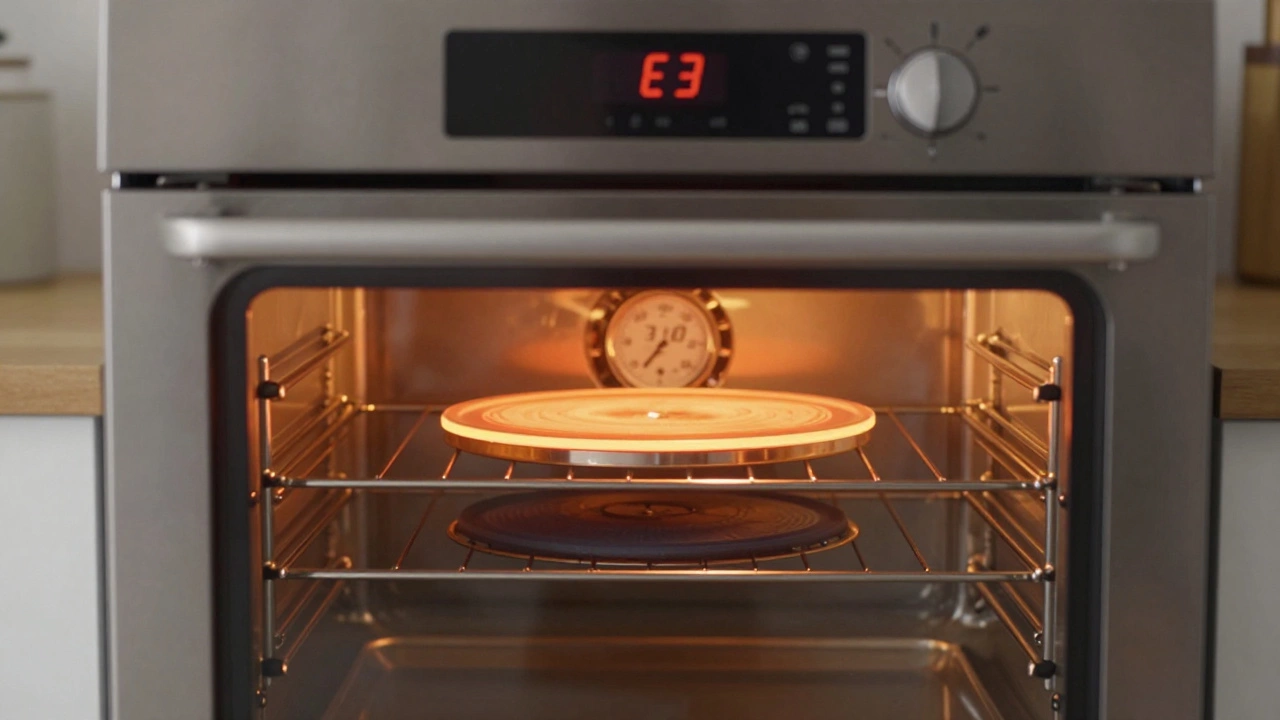
If your electric oven won’t heat up, takes forever to cook, or smells like burning plastic, it’s not just being slow-it might be broken. Unlike gas ovens, electric ones don’t have flames you can see, so problems are harder to spot. But there are clear, reliable signs that tell you when it’s time to call a repair tech instead of just turning the dial higher.
Your oven doesn’t heat at all
The most obvious sign is when you turn the oven on and nothing happens. No glow from the heating elements, no hum, no warmth after 15 minutes. First, check your circuit breaker. A tripped breaker is the easiest fix-if the breaker for the oven has flipped, reset it and try again. If it trips again, that’s not a coincidence. It means there’s a short in the wiring or the heating element is drawing too much current.
If the breaker is fine, look at the bake and broil elements. Both should glow bright orange when working. If one stays dark, it’s likely burned out. You can’t fix a broken element-only replace it. Most electric ovens have two separate elements, so if the broil element works but the bake element doesn’t, your oven can’t reach or hold proper temperatures for baking.
Food takes way longer to cook
Maybe your oven turns on, but your cookies burn on the edges and stay raw in the middle. Or your roast takes three hours instead of two. That’s not your recipe-it’s your oven. A failing heating element, a weak thermostat, or a damaged temperature sensor can cause uneven or insufficient heat.
Test it with an oven thermometer. Place it in the center of the middle rack, set the oven to 350°F (175°C), and wait 20 minutes. If the thermometer reads below 325°F or above 375°F, your oven’s temperature control is off. This isn’t just inconvenient-it’s unsafe. Undercooked meat or underbaked cakes can carry bacteria. Most ovens are designed to stay within ±10°F of the set temperature. If you’re outside that range, the control system is faulty.
The oven light works but nothing else does
It’s a weird but common scenario: the interior light turns on when you open the door, but the oven won’t heat. That tells you the power is getting to the oven’s control panel. If the light works but the elements don’t, the issue is likely the thermostat, the control board, or a wiring connection between the board and the heating elements. The thermostat is the most common culprit. It’s a small sensor that tells the oven when to turn the heat on and off. If it’s stuck or misreading, the oven thinks it’s already hot-even when it’s not.
Replacing a thermostat isn’t hard for a technician, but it’s not something you should DIY unless you’ve worked with high-voltage appliances before. The wires carry 240 volts-enough to kill. Don’t risk it.
Unusual smells or smoke
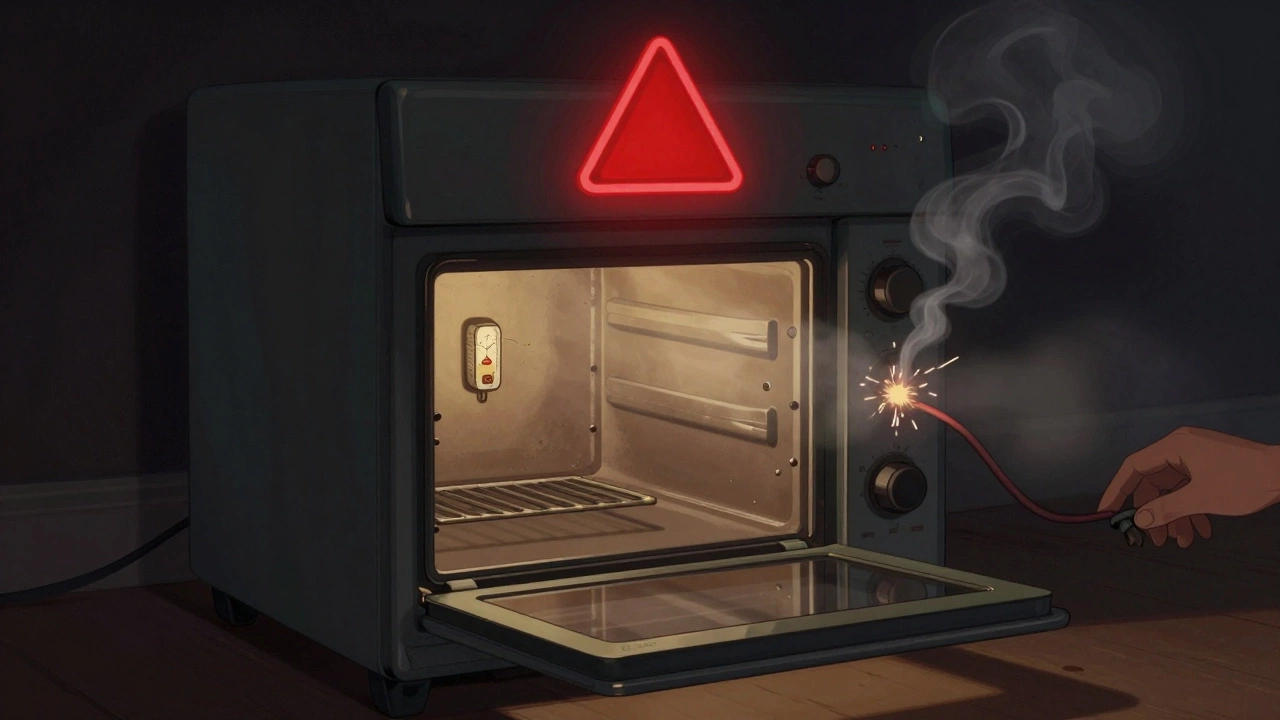
A new oven sometimes gives off a faint plastic smell the first few times you use it-that’s normal. But if you’ve had your oven for years and suddenly smell burning rubber, ozone, or metal, something’s wrong. Burning insulation on wires inside the oven can cause that smell. It’s often caused by a loose connection or a failing component overheating.
If you see smoke coming from the vents or around the door seal, turn the oven off immediately and unplug it. Smoke means something is overheating to the point of melting. This isn’t a "wait and see" situation. Left unchecked, it can lead to a fire. Even if the smoke stops after turning it off, don’t use the oven again until a technician checks it.
The oven turns on and off randomly
Some people think it’s normal for ovens to cycle on and off-that’s true. But if it’s turning off every 5 minutes or buzzing loudly before shutting down, something’s wrong. A failing relay on the control board can cause erratic cycling. Or the temperature sensor might be sending false signals, making the oven think it’s overheating when it’s not.
Try this: set the oven to 350°F and watch it for 10 minutes. If it turns off for 30 seconds, then back on, that’s normal cycling. But if it shuts off completely, the fan stops, and the light dims, that’s a sign the control board is struggling to manage power. Control boards fail often in older ovens-especially in homes with old wiring or frequent power surges. If your oven is over 10 years old, this is a common end-of-life symptom.
The display is glitchy or shows error codes
Modern electric ovens have digital displays that show error codes like F1, E3, or Err. These aren’t random-they’re diagnostic messages. Look up your oven’s model number and find the manual online. Most manufacturers list what each code means. For example:
- F1 often means a faulty control board
- E3 usually points to a broken temperature sensor
- Err can mean a door lock failure (on self-cleaning models)
Some codes are fixable with a reset. Unplug the oven for 5 minutes, then plug it back in. If the code comes back, it’s not a glitch-it’s a hardware failure. Don’t ignore error codes. They’re the oven’s way of telling you exactly what’s wrong.
It’s older than 10-15 years
Even if your oven still works, age matters. Electric ovens typically last 10 to 15 years. After that, parts become harder to find, and the cost of repairs often exceeds the value of the appliance. If you’re spending $200 to replace a thermostat in a 12-year-old oven, you’re better off replacing the whole unit.
Newer ovens are more energy-efficient. An oven from 2010 uses about 2.4 kWh per hour at full power. A 2025 model uses closer to 1.8 kWh. That’s a 25% drop in energy use. Over a year, that adds up to $50-$80 in savings. Plus, modern ovens have better temperature accuracy, convection fans, and safety shutoffs.
If your oven is older than 15 years and you’re having multiple issues, replacement is smarter than repair. You’ll save money in the long run and avoid the risk of a sudden breakdown during a holiday meal.
What to do next
Don’t guess. Start with the simplest checks:
- Check the circuit breaker
- Test the temperature with an oven thermometer
- Look for glowing heating elements
- Check for error codes on the display
- Smell for burning or smoke
If you’ve ruled out the breaker and the thermometer shows a big temperature swing, it’s time to call a technician. Don’t waste money on generic oven repair kits sold online-they rarely fix the real problem.
Most repairs cost between $150 and $400. Replacing a heating element is $100-$200. A control board replacement is $250-$400. If the quote is over $400 and your oven is over 10 years old, ask for a replacement quote instead. Many repair shops will give you a free estimate and will tell you if replacement is the better option.
And if you’re replacing it, look for models with convection heating, a self-cleaning cycle with a lock safety feature, and a digital thermometer probe. These features make cooking easier and safer-and they’re standard now, not luxury extras.
Can a faulty oven cause a fire?
Yes. Faulty wiring, damaged heating elements, or a failing control board can overheat and ignite nearby insulation or grease buildup. If you smell burning plastic or see smoke, turn off the oven and unplug it immediately. Never ignore these signs.
Why does my oven heat unevenly?
Uneven heating is usually caused by a failing bake or broil element, a broken fan in convection ovens, or a damaged temperature sensor. It can also happen if the oven rack is placed too close to the heating element. Always use an oven thermometer to confirm the actual temperature.
Is it worth repairing an old electric oven?
It depends. If your oven is under 10 years old and the repair cost is under $300, it’s usually worth it. If it’s older than 12 years, or the repair costs more than half the price of a new oven, replacement is smarter. New models are more efficient and reliable.
Can I replace a heating element myself?
Technically yes, but it’s risky. Electric ovens use 240 volts, and one mistake can cause electrocution or damage the control board. If you’ve never worked with high-voltage appliances, hire a technician. The part costs $30-$80, but labor is $100-$150. It’s not worth risking your safety.
How often should I clean my electric oven?
Clean spills as soon as they cool to prevent smoke and odors. For deep cleaning, use the self-clean cycle once every 3-6 months, depending on use. Never use oven cleaners on self-cleaning models-they can damage the enamel lining. Always ensure the door locks properly during self-clean mode.