
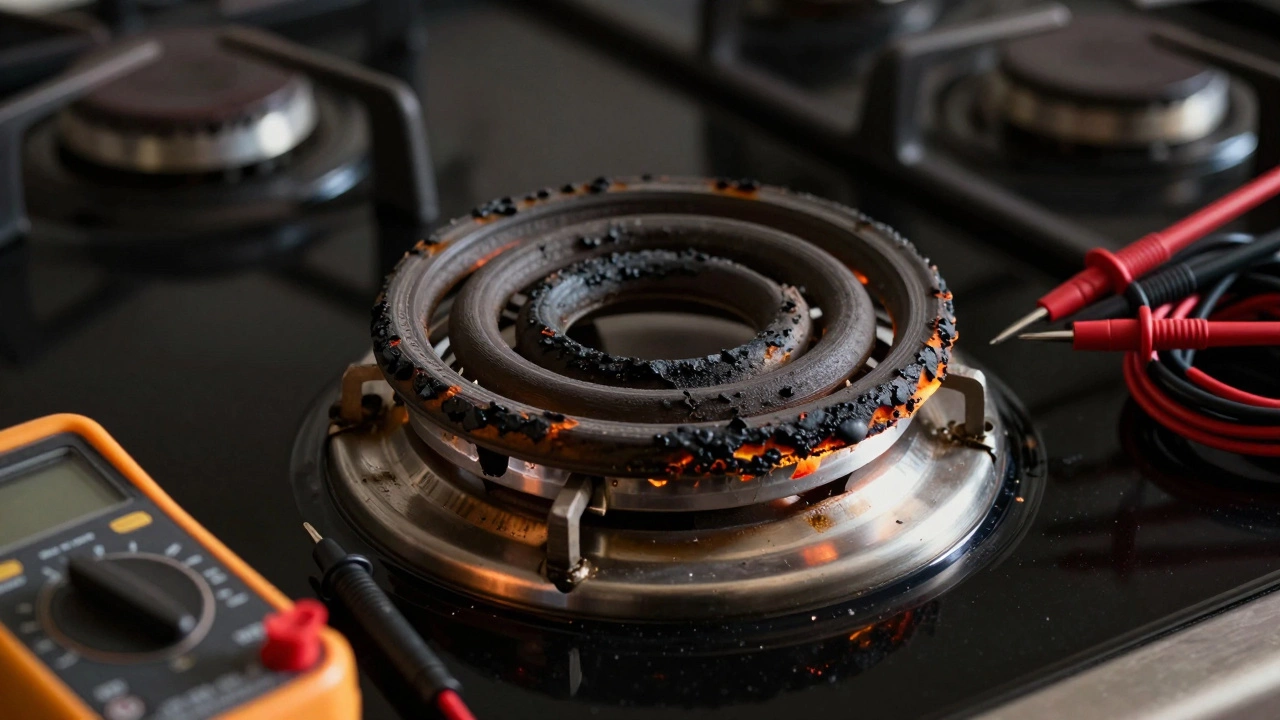
If your electric stove won’t heat up, or one burner is acting up while the others work fine, chances are the heating element is done. It’s a common problem-and usually easy to fix. You don’t need to be a technician to check it yourself. Most people replace the element without calling a pro. Here’s how to know for sure if your electric stove element is bad.
Look for visible damage
Start by turning off the power at the breaker. Safety first. Then pull out the stove and take a close look at the element. The heating coil should be smooth and evenly glowing when it’s working. If you see any of these signs, the element is likely dead:- Burnt, blackened, or blistered spots
- Cracks or gaps in the coil
- Sections that look melted or sagging
- Loose or broken wires connected to the element
Even small breaks you can barely see can stop electricity from flowing through the coil. If the element looks like it’s been through a fire, it’s done. No point in testing-it’s gone.
Test with a multimeter
If the element looks okay, don’t assume it’s good. A broken element can look fine but still not work. The only way to know for sure is to test it with a multimeter. You can buy one at any hardware store for under $20.First, unplug the stove or turn off the circuit breaker. Then remove the element by unscrewing the two mounting screws and gently pulling it out. You’ll see two metal terminals at the back where the wires connect. Set your multimeter to ohms (Ω), usually the 200 setting.
Touch one probe to each terminal. If the meter reads between 20 and 120 ohms, the element is fine. If it shows OL (open loop) or no reading at all, the element is broken. Some models might read as low as 15 ohms or as high as 150, depending on size. If you’re unsure, check the manufacturer’s specs online.
Don’t test the element while it’s still plugged in. That’s how people get shocked. Always disconnect power before touching any wiring.
Check if the burner works on another setting
Sometimes the problem isn’t the element-it’s the control switch or the infinite switch that regulates power. If your stove has dual burners (like a large ring and a small ring), test both settings. If the large ring works but the small one doesn’t, the issue is likely the switch, not the element.Also, try turning on the element on a different stove top. If it works there, your element is fine. If it doesn’t, the problem is probably the element or its wiring. This is a quick way to rule out a faulty control panel.
Listen for clicking or smell for burning
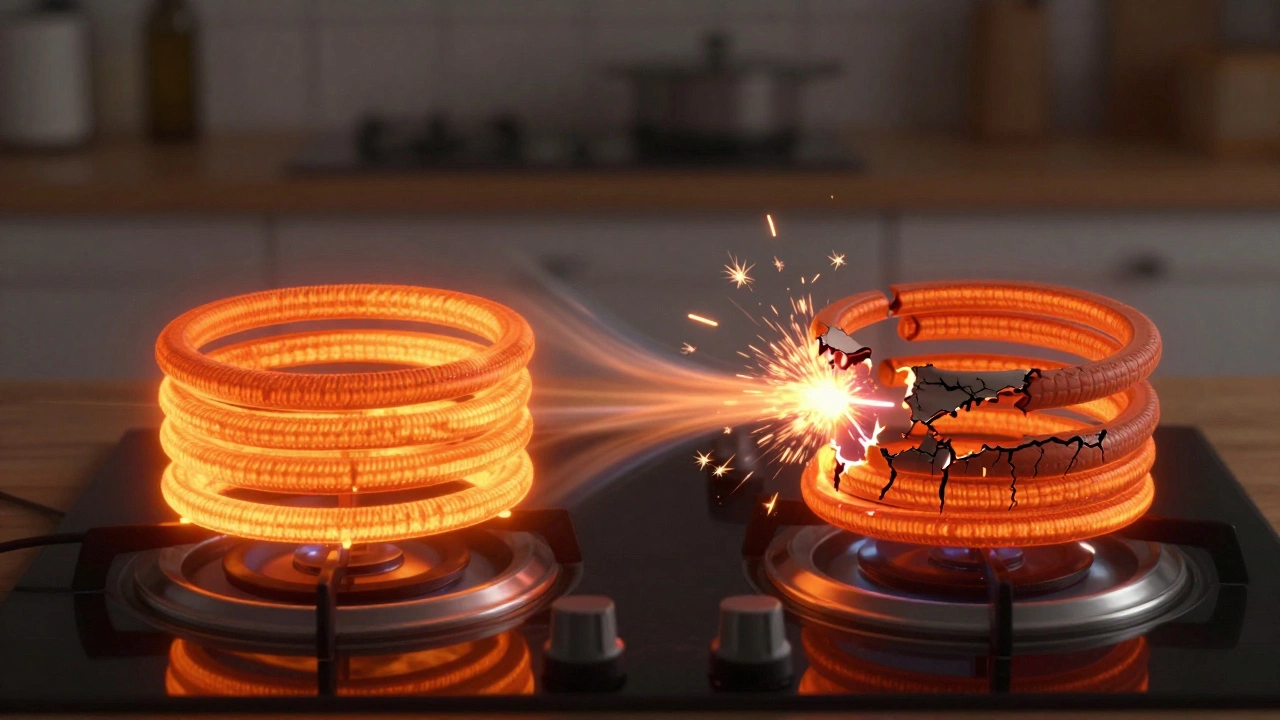
When you turn on a working element, you usually hear a soft click as the switch engages. If you hear nothing, and the element doesn’t glow, that’s a red flag. You might also smell a burning odor, especially if the element is shorting out internally. That smell often means the insulation inside the coil has broken down, letting electricity arc where it shouldn’t.That smell is not normal. Don’t ignore it. It can lead to a fire. If you smell burning and the element isn’t glowing, turn off the power immediately and replace the element.
Compare with other working elements
If your stove has multiple burners, turn them all on at the same time. Watch how they glow. A good element glows bright orange-red evenly along its entire length. A bad one might glow only in patches, or not at all. If one burner is noticeably dimmer than the others, even on high heat, it’s failing.Also, pay attention to how long it takes to heat up. A healthy element boils water in 5-7 minutes. If it takes 15 minutes or more, or never gets hot enough, the element is losing power. This is a slow failure-you might not notice until you’re trying to cook and everything takes forever.
Check the receptacle and wiring
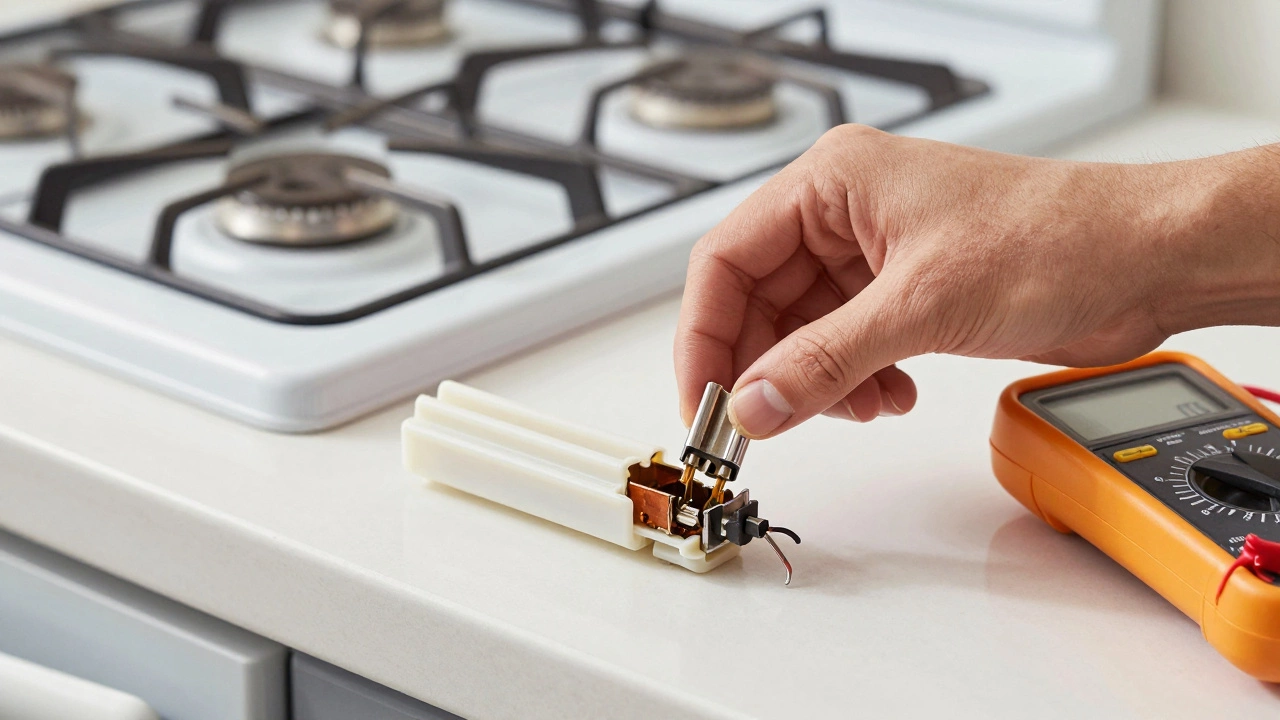
Sometimes the element is fine, but the socket it plugs into is damaged. Over time, heat and wear can melt the plastic housing or corrode the metal contacts. If the element looks good and tests okay but still doesn’t work, the receptacle might be the issue.Look for dark spots, melted plastic, or loose wires around the receptacle. You can test it with a multimeter too-set it to volts and carefully probe the terminals while the stove is turned on (only if you’re comfortable with live voltage). If you get no voltage reading, the problem is upstream: a broken wire, faulty switch, or blown fuse.
If you’re not confident working with live wires, skip this step. Replace the element first. If that doesn’t fix it, then call a technician.
How long do stove elements last?
Most electric stove elements last 5 to 10 years. But that depends on how often you use them. If you cook daily, especially with high heat, they wear out faster. Spilled sugar, grease, or water can also damage the element over time. Salt from boiling water can corrode the terminals. Poor ventilation in the kitchen can trap heat and shorten lifespan.Some brands last longer. Frigidaire, GE, and Whirlpool elements often last 7-8 years on average. Cheaper models or knock-offs might fail in 3-4 years. Check your model number and look up replacement parts. Genuine parts usually last longer than generics.
What to do if the element is bad
Replacing a bad element is simple. You don’t need special tools. Just:- Turn off the power at the breaker.
- Remove the old element by unscrewing the mounting screws and pulling it out.
- Unplug the wires from the terminals.
- Plug the new element in and reconnect the wires the same way.
- Screw it back in place.
- Turn the power back on and test it.
Elements are cheap-usually between $25 and $60. You can order them online using your stove’s model number. Most come with instructions. Take a photo of the old element and its wiring before you remove it. That way, you won’t mix up the connections.
Don’t try to repair a broken element with tape or glue. That’s dangerous. The only safe fix is replacement.
When to call a professional
If you’ve replaced the element and it still doesn’t work, the problem is deeper. It could be:- A faulty infinite switch
- A blown thermal fuse
- A broken control board
- Wiring damage inside the stove
These are harder to diagnose. If you’re not comfortable opening up the control panel or testing live circuits, call a repair technician. It’s not worth the risk. A good technician will charge $80-$150 to fix it, which is still cheaper than buying a new stove.
Also, if your stove is over 15 years old, think about replacing the whole unit. Older stoves are inefficient, harder to find parts for, and may not meet modern safety standards.