
Oven Repair vs Replacement Cost Calculator
Calculate whether repairing your 10-year-old oven makes financial sense based on repair costs and replacement prices. Follows the industry rule: repair costs over 50% of a new oven's price should be replaced.
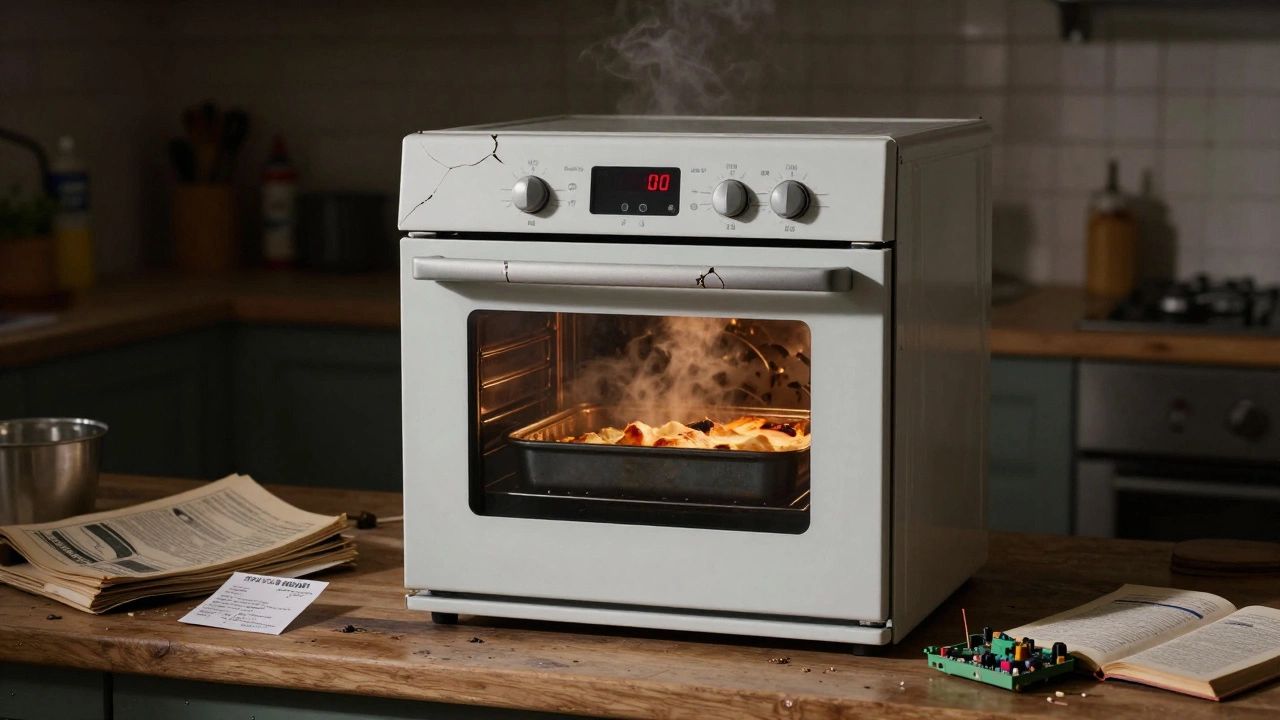
You turn on your oven for dinner, and it takes forever to heat up. The burner flickers. The display glitches. You sigh and wonder: is it worth fixing a 10-year-old oven? It’s not broken yet-but it’s not working right either. You’ve heard old appliances last forever, but you’ve also seen neighbors replace theirs and swear it was worth it. So what’s the real answer?
How long do ovens actually last?
Most ovens last between 10 and 15 years. That’s not a guess-it’s what manufacturers and repair professionals see in the field. The average lifespan of a gas oven is about 13 years. Electric ovens tend to last a little longer, around 14 to 15 years, because they have fewer moving parts. But that doesn’t mean your oven will die exactly on day 3,650. Some last 20 years with care. Others give out at 8 because they were cheaply made or poorly maintained.
Age isn’t the only factor. How often you use it matters. A family that bakes every weekend wears out elements faster than someone who uses the oven once a week. If your oven has been through multiple power surges, hasn’t been cleaned in years, or has had repeated repairs, it’s already on borrowed time.
What’s broken? The repair cost tells the story
Not all oven problems are equal. Some fixes are cheap and simple. Others cost half as much as a new oven-and still don’t fix the real problem.
- Thermostat or temperature sensor failure: This is common in older models. Replacement parts cost $25-$60. Labor runs $100-$150. Total: under $200. This is usually worth fixing.
- Heating element burnout: Electric ovens lose elements over time. A new element costs $30-$80. Labor: $100-$120. Total: $130-$200. Again, a solid fix.
- Igniter failure (gas ovens): A bad igniter won’t light the gas. Parts: $20-$50. Labor: $100-$150. Total: $120-$200. Worth fixing.
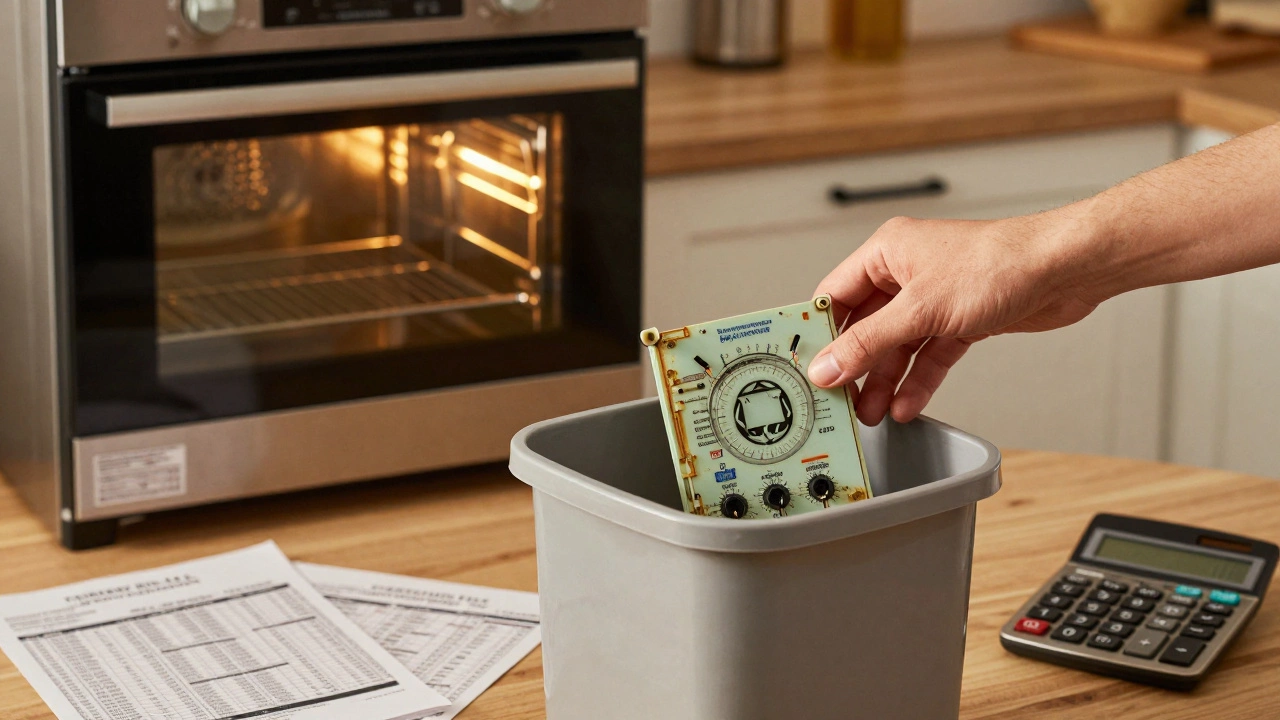
- Control board failure: This is the brain of the oven. If the display is dead, buttons don’t respond, or error codes keep popping up, the control board may be fried. Parts: $150-$300. Labor: $150-$250. Total: $300-$550. At this point, you’re spending nearly half the price of a new oven.
- Door seal or hinge damage: If heat escapes or the door doesn’t close right, efficiency drops. Replacing the seal costs $20-$50. Hinges are $40-$80. Labor: $80-$120. Total: under $200. Fixable, but check for other issues too.
Here’s the rule of thumb: if the repair costs more than 50% of a new oven’s price, walk away. For a mid-range oven that costs $600-$800, that means anything over $300-$400 is a red flag.
Energy efficiency: The hidden cost of an old oven
Older ovens aren’t just slow-they’re hungry. A 10-year-old oven uses about 20-30% more energy than a new one. That might not sound like much, but over five years, it adds up.
Let’s say you bake for 2 hours a week. Your old oven pulls 2.5 kW. A new Energy Star model pulls 1.9 kW. That’s 0.6 kW saved per hour. Over 104 hours a year, you save 62.4 kWh. At $0.15 per kWh, that’s $9.36 saved annually. Sounds small? Multiply that by five years: $47. That’s not enough to buy a new oven.
But here’s the catch: modern ovens have better insulation, smarter sensors, and faster preheats. You’re not just saving energy-you’re saving time. And if your oven struggles to hold temperature, you’re wasting food. Burnt cookies, undercooked roasts, uneven baking-those aren’t just annoyances. They’re money down the drain.
Replacement cost: What does a new oven actually cost?
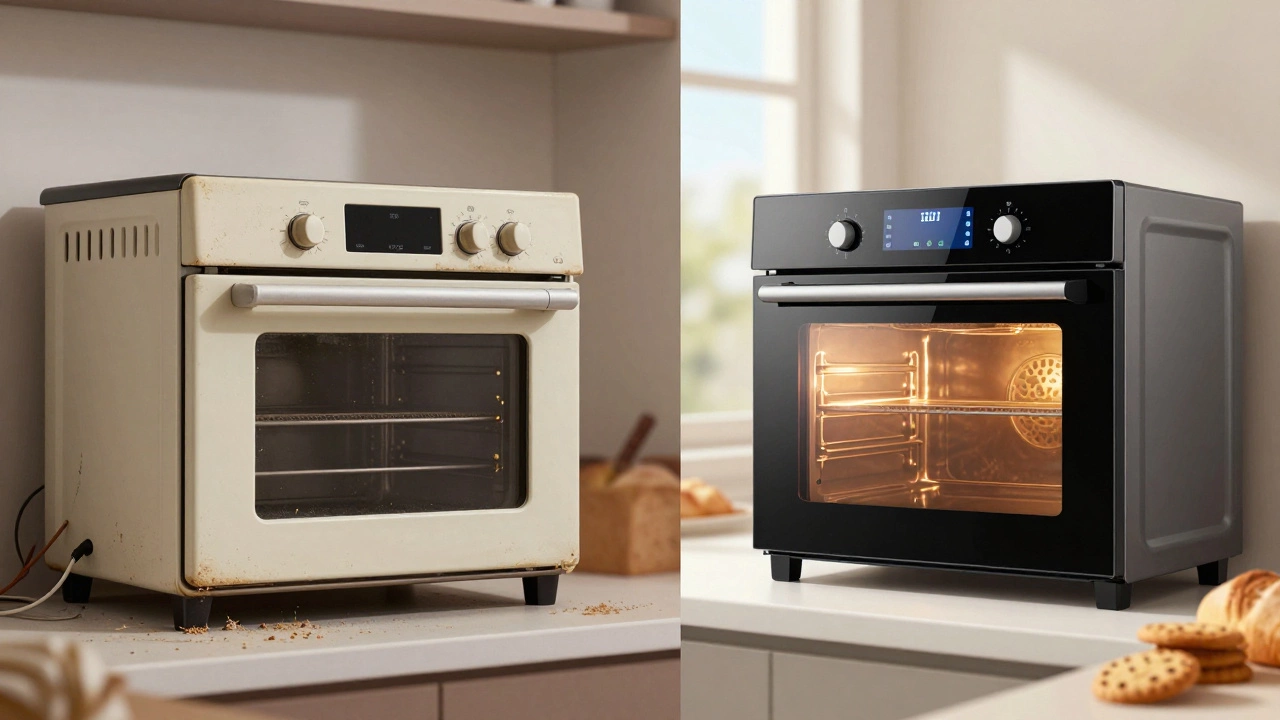
Basic electric or gas ovens start at $500-$700. Mid-range models with convection, steam, or smart features run $800-$1,200. High-end built-ins with dual ovens or Wi-Fi controls can hit $2,500 or more.
Installation isn’t free. If you’re replacing a built-in oven, expect $150-$300 for removal and hookup. If your wiring or gas line needs updates, add another $200-$500. That’s why many people delay replacement-they’re scared of the total bill.
But here’s what most people don’t realize: new ovens come with warranties. A standard one-year warranty covers parts and labor. Some brands offer 5-year warranties on heating elements. That’s peace of mind you don’t get with a 10-year-old oven patched together with duct tape and hope.
When to walk away: The 3 warning signs
Not every old oven needs to be replaced. But if you see any of these, it’s time to start shopping:
- Multiple repairs in the last two years: If you’ve fixed the same oven three or more times since it turned 8, you’re throwing money into a sinking ship.
- Parts are discontinued: Manufacturers stop making parts for ovens after 10 years. If your model is from 2015, finding a replacement control board might take weeks-or cost $400 because it’s a specialty item.
- It’s unsafe: Gas leaks, sparking wires, or a door that doesn’t seal properly aren’t just inconvenient. They’re dangerous. No repair is worth risking your home.
One customer I worked with had a 12-year-old oven that kept shutting off. The repairman said it was the control board. He quoted $420. She asked, "What if I just get a new one?" He said, "Then you get a 10-year warranty, better efficiency, and you won’t have to worry about this again." She bought a new oven for $850. Two years later, she still talks about how much easier it is to cook with.
What about selling or donating your old oven?
Most thrift stores won’t take broken ovens. Scrap yards pay $5-$20 for metal, but you’ll need to remove the glass and wiring yourself. Some cities offer free pickup for old appliances if you buy a new one from a retailer that offers haul-away service.
Don’t assume your old oven has value. Unless it’s a vintage model from the 1950s or a high-end brand like Wolf or Viking, it’s just a burden. The cost of moving it, storing it, or cleaning it up often outweighs any resale value.
The emotional factor: Why you want to fix it
Let’s be honest-you’re not just thinking about money. You’re thinking about memories. That oven baked your kids’ birthday cakes. It roasted your Thanksgiving turkey for a decade. You don’t want to let it go.
That’s normal. But holding onto a failing appliance out of guilt isn’t loyalty-it’s self-sabotage. You’re not honoring the oven. You’re punishing yourself with unreliable meals, higher bills, and constant worry.
Replacing it isn’t betrayal. It’s progress. Modern ovens are smarter, safer, and more reliable. You’ll still make the same meals. You’ll just do it better.
Final decision: Is it worth fixing a 10-year-old oven?
If your oven is 10 years old and the problem is a simple part-like a heating element or thermostat-then yes, fix it. Spend under $200, and you’ll get another 2-3 years out of it.
If the problem is the control board, the oven’s been repaired before, or it’s using too much energy, then no. It’s not worth it. Spend that money on a new oven with a warranty, better efficiency, and modern features. You’ll save more in the long run.
And if you’re unsure? Call a local repair tech. Ask them: "If this was your oven, would you fix it?" Most honest technicians will tell you the truth. And if they push you to spend $400 on a 10-year-old appliance? Walk out. You’re better off.
Is it cheaper to repair or replace a 10-year-old oven?
It depends on what’s broken. Simple repairs like a heating element or thermostat usually cost under $200 and are worth it. But if the control board is faulty, repairs can cost $300-$550-nearly half the price of a new oven. At that point, replacement is almost always the better financial choice.
How long should a 10-year-old oven last after a repair?
If you fix a minor issue like a sensor or element, you might get another 2-3 years. But if the oven is already 10 years old and you’re replacing a major component like the control board, don’t expect it to last more than 1-2 years. Older ovens have worn-out parts throughout-they’re not just broken in one place.
Can a 10-year-old oven be energy efficient?
Not really. Ovens built before 2015 lack modern insulation, sensors, and smart tech. Even if it works, it uses 20-30% more energy than a new model. That adds up to $50-$100 extra per year in electricity or gas bills.
Do new ovens really last longer?
Not necessarily-modern ovens still average 10-15 years. But they’re built with better materials, better warranties, and fewer failure points. Plus, you get features like self-cleaning, precise temperature control, and faster preheats that make daily use easier and more reliable.
Should I replace my oven if it still works?
Only if you’re tired of the problems. If it heats unevenly, takes forever to preheat, or keeps throwing error codes, it’s not working well-even if it’s "on." A new oven will save you time, energy, and stress. Don’t wait for it to break completely. Plan ahead.