

Hot Water Heater Element Diagnostic Tool
Enter your multimeter reading or select observed symptoms to determine if your heating element needs replacement.
Multimeter Test (Ohms)
Symptom Checklist
Select all that apply to your situation:
Safety First!
Always turn off the power at the circuit breaker before removing access panels or touching wires. Verify with a non-contact voltage tester. If you are unsure about electrical safety, call a professional.
You step into the shower expecting a warm embrace, but instead, you get a shock of cold water that makes your toes curl. Or maybe the water is lukewarm at best, forcing you to stand there shivering while trying to decide if it’s worth staying in or just giving up and getting out. This isn’t just an inconvenience; it’s a signal. Your hot water heater is struggling, and more often than not, the culprit is a failed heating element. Before you call a plumber or buy a new unit, you need to know if the problem is actually the element itself. It’s a common failure point, but it’s also easy to misdiagnose. Let’s figure out exactly what’s going on inside your tank.
The Anatomy of Your Heated Shower
To understand why things break, you have to know how they work. Most residential electric water heaters use two separate components called heating elements. These are essentially large resistors that convert electrical energy into heat. One sits near the bottom of the tank (the lower element) and one sits near the top (the upper element). They are screwed directly into the tank wall, submerged in water, and sealed with gaskets to prevent leaks.
Here is the critical part most people miss: they don’t work simultaneously. The thermostat controls them in sequence. When you use hot water, cold water enters from the bottom, cooling the lower thermostat first. This triggers the lower element to heat the incoming cold water. Once that section reaches the set temperature, the upper thermostat takes over to keep the rest of the tank hot. If you only have one element working, you’ll still get some hot water, but it will run out quickly because you’re only heating half the tank. If neither works, you get nothing but cold water.
Symptom Check: What Does Failure Look Like?
A bad element doesn’t always mean zero hot water. In fact, total failure is rare unless both elements die at once, which is uncommon. Instead, look for these specific patterns:
- Inconsistent Temperature: You get hot water for ten minutes, then it turns cold. This usually means the lower element has failed. You’re relying solely on the upper element, which can only heat the top portion of the tank.
- Lukewarm Everywhere: The water never gets truly hot, just tepid. This suggests partial element failure or a thermostat issue where the element isn’t reaching full power.
- Higher Electricity Bills: If your bill spikes without a change in usage, a shorted element might be drawing excess current, or the system is running constantly trying to reach a temperature it can’t maintain.
- No Hot Water At All: This points to a tripped breaker, a blown fuse, or both elements being dead. It could also be a faulty thermostat, so don’t assume it’s the element yet.
Notice anything missing? Leaks. While a bad seal around an element can cause leaks, a cracked element itself rarely leaks externally. So if you see water dripping from the side of the tank, check the connections before blaming the element.
The Multimeter Test: Confirming the Diagnosis
Guessing costs money. Testing costs five minutes and a basic tool. To confirm if an element is bad, you need a multimeter, a device used to measure voltage, resistance, and continuity. You do not need to drain the tank for this test, but you must cut the power.
First, turn off the circuit breaker supplying power to the water heater. Never skip this step. Electric water heaters are dangerous when live. Remove the access panel covers (usually plastic screws or clips) and peel back the insulation to expose the thermostats and element terminals. You will see two sets of wires connected to each element.
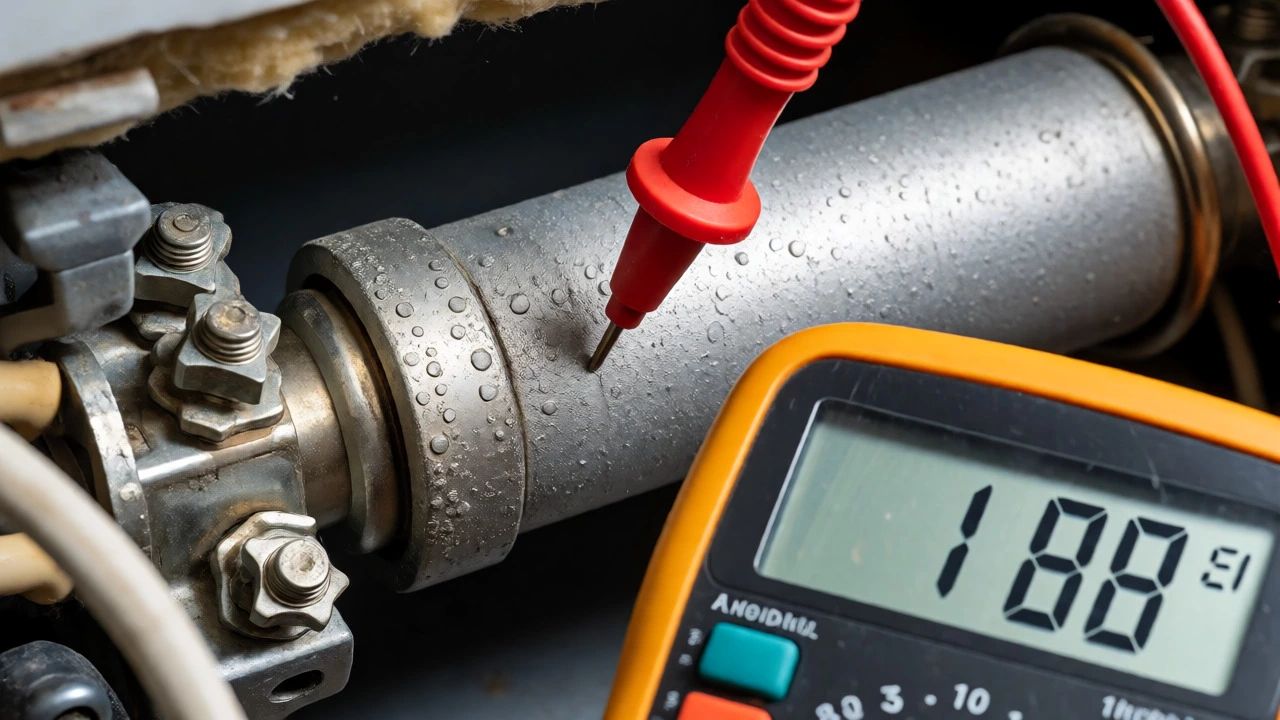
Set your multimeter to the Ohms (Ω) setting. Touch one probe to one terminal of the element and the other probe to the second terminal. A healthy element typically reads between 10 and 16 ohms. If the meter shows "OL" (Open Loop) or infinity, the internal wire is broken. That element is dead. If it reads close to zero, it’s shorted internally, which is also a failure.
| Reading | Meaning | Action Required |
|---|---|---|
| 10-16 Ω | Normal Range | Element is likely good; check thermostats next. |
| OL / Infinity | Open Circuit | Element is broken. Replace immediately. |
| 0-5 Ω | Short Circuit | Element is damaged. Replace immediately. |
Checking the Thermostat: The Silent Saboteur
If your elements test fine, the problem might be the thermostat, the component that regulates temperature by switching power to the elements. Thermostats fail frequently, often due to sediment buildup causing overheating or simple age-related wear.
Look for a red reset button on the thermostat. If it’s popped out, press it back in. This resets the high-limit safety switch. If the heater starts working again, great-but investigate why it tripped. Frequent trips indicate a failing thermostat or severe sediment issues.
You can also test the thermostat for continuity. With the power off, disconnect the wires and set the multimeter to continuity mode (the symbol looks like sound waves). Place probes on the input and output terminals. Turn the thermostat dial up and down. You should hear a beep when the circuit closes (power on) and silence when it opens (power off). If it stays silent or stays loud regardless of position, the thermostat is stuck and needs replacement.
Sediment: The Element Killer
Why do elements fail? Often, it’s not age-it’s neglect. Hard water contains minerals like calcium and magnesium. Over time, these settle at the bottom of the tank as sediment. The lower heating element is buried in this sludge.
When an element is covered in sediment, it can’t transfer heat efficiently into the water. The heat builds up inside the metal sheath instead of escaping, causing the element to overheat and burn out. This is why flushing your water heater annually is crucial. If you haven’t flushed your tank in years, and you have hard water, the lower element is almost certainly compromised.
Before replacing an element, consider draining the tank. If you see thick mud coming out, clean the area around the element threads carefully. Installing a new element into a dirty tank is a waste of time; it will fail just as fast.
Replacing the Element: What You Need to Know
If you’ve confirmed a bad element, buying a replacement is straightforward, but installation requires care. First, identify the type. Most standard tanks use screw-in elements, while some commercial units use flange-mounted ones. Also, check the wattage and voltage rating printed on the old element. Common residential ratings are 3800W, 4500W, or 5500W at 240V. Using the wrong wattage can trip breakers or shorten lifespan.
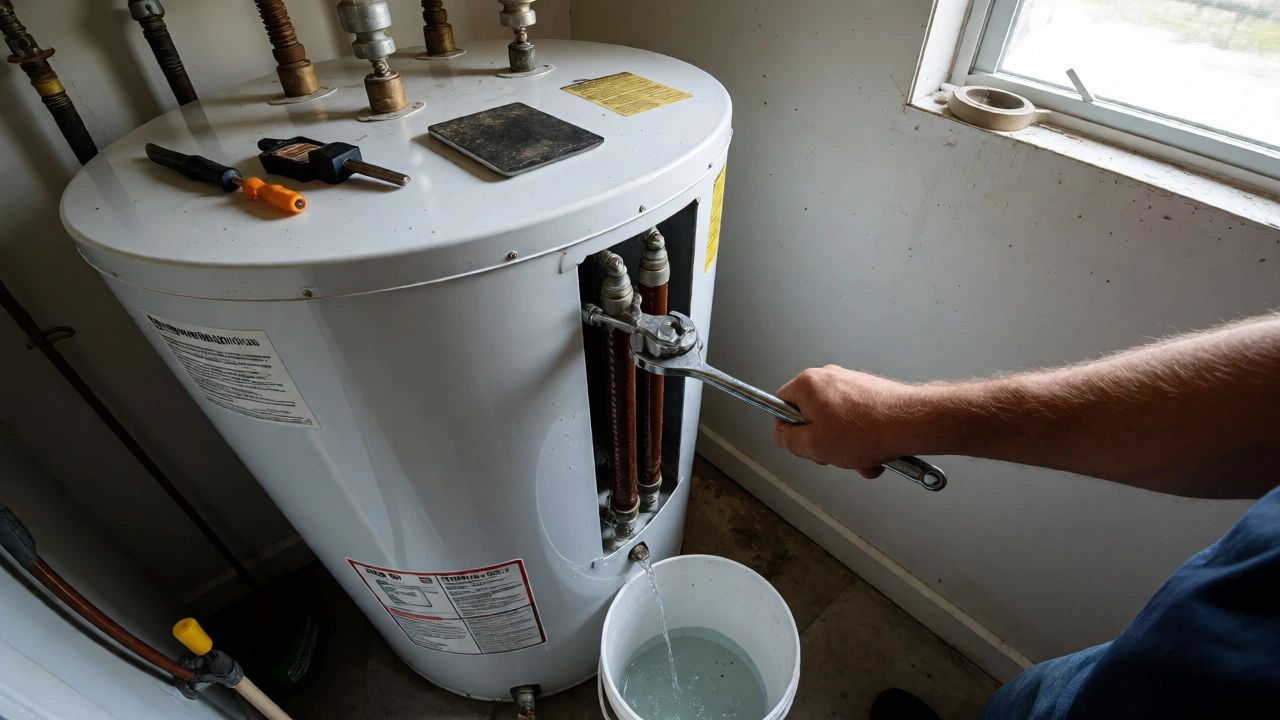
Drain the tank below the level of the element you are replacing. For the lower element, this means draining nearly all the water. Use an element wrench (a specialized socket) to unscrew the old part. Be prepared for a mess-water will spill out. Clean the threads in the tank thoroughly with a rag or brush. Any debris left behind will prevent a proper seal.
Apply pipe joint compound or Teflon tape to the threads of the new element (check manufacturer instructions; some prefer one over the other). Screw it in hand-tight, then use the wrench to tighten it firmly. Do not overtighten, as this can crack the porcelain coating on the element or strip the tank threads. Refill the tank before turning the power back on. Running an electric element dry for even a few seconds can destroy it instantly.
When to Call a Pro
DIY is great for saving money, but water heater repairs involve electricity and pressurized water. Call a professional if:
- You are uncomfortable working with live circuits (even after turning off the breaker, verify with a non-contact voltage tester).
- The tank is leaking from the body, not just the element connection.
- You have a gas water heater (different troubleshooting logic applies).
- The unit is over 10 years old. Replacing an element on an aging tank might just delay the inevitable cost of a new water heater.
Remember, safety comes first. If you smell burning plastic or see scorch marks on the wiring, stop immediately. That indicates a serious electrical fault that requires expert attention.
Can I replace a hot water heater element myself?
Yes, if you are comfortable with basic tools and safety precautions. You need a multimeter, an element wrench, and a bucket. The key steps are turning off power, draining the tank, removing the old element, and installing the new one with proper sealing. Always refill the tank before restoring power to avoid burning out the new element.
How long do hot water heater elements last?
Typically, heating elements last between 8 and 10 years. However, this varies significantly based on water quality. In areas with hard water, elements may fail in as little as 3 to 5 years due to mineral buildup insulating the element and causing it to overheat.
What does a bad heating element feel like?
You won't feel the element itself, but you'll notice the effects: lukewarm showers, running out of hot water too quickly, or no hot water at all. Sometimes, a failing element causes the circuit breaker to trip repeatedly due to a short circuit.
Do I need to drain the whole tank to change an element?
For the lower element, yes, you must drain the tank below its location, which is nearly all the water. For the upper element, you only need to drain enough water to bring the level below the top of the tank, usually about 10-15 gallons, depending on the tank size.
Why is my water heater making noise?
Popping or rumbling noises are usually caused by sediment buildup trapping steam bubbles under the element. When these bubbles burst, they create noise. While not always a sign of a bad element, it indicates heavy sediment that will eventually kill the element if not flushed out.